Emergency And Outages

If you are experiencing a power outage in one of the 16 First Nations connected to the provincial grid via the Wataynikaneyap system, call Hydro One Remotes at 1-888-825-8707. Power distribution is the responsibility of Hydro One Remotes. They are prepared to respond 24/7 to outages and other issues.

20
08

October 2008: The original Central Corridor Energy Group was given the mandate to pursue the planning and development of an electrical transmission line, owned by the First Nations, to connect 10 communities to the provincial electricity grid. The original Central Corridor Energy Group included 13 First Nations: Bearskin Lake, Cat Lake, North Caribou Lake, Sachigo Lake, Kingfisher Lake, Wunnumin Lake, Wapekeka, Kasabonika Lake, Wawakapewin, Muskrat Dam, Kitchenuhmaykoosib Inninuwug, Mishkeegogamang, and Saugeen. (Mishkeegogamang and Saugeen subsequently left the Group and re-joined the project later.)
20
09

2009: Completed studies to identify a route to connect 10 off-grid communities. All members of CCEG agreed that any and all proposals require extensive consultations. Steps were taken to secure funding to allow community engagement to coincide with the development of the Business Plan.

20
11

February 2011: Expanded mandate to include the transmission line discussions south of Pickle Lake.

20
12

March 2012: Expanded mandate to welcome Slate Falls First Nation and Lac Seul First Nation as partners. Communities signed partnership agreement (as 1876981 Ontario Inc.) which has since evolved into the First Nation Limited Partnership.

May 17, 2012: Nishnawbe Aski Nation (NAN) Resolution to support and advocate to promote the Wataynikaneyap Power initiative.

20
13

October 2013: Expanded mandate to include connection of five Keewaytinook Okimakanak First Nations and as partners. Wataynikaneyap Power engaged PwC to assess the feasibility of connecting 16 off-grid communities.

December 2013: Ministry of Energy releases Ontario’s 2013 Long-Term Energy Plan, which included the following: “Connecting the remote communities is a priority for Ontario. Ontario will continue to work with the federal government to connect remote First Nation communities to the electricity grid or find alternatives where it is not economically feasible to do so. Success in connecting the remote communities will depend on contributions from all of the parties that benefit from the new transmission lines and other infrastructure, particularly the federal government, whose commitment and co-operation will be required to make this priority project a reality. The federal government, which is responsible for supporting First Nation community infrastructure, would also share in the savings, as the costs associated with using diesel fuel would be reduced. The federal government would receive additional benefits beyond the diesel related savings. Once the remote communities are connected, there would be a reduction in the environmental impact and environmental liabilities associated with diesel spills, lower greenhouse gas emissions, improved social and living conditions for remote community residents, and increased opportunities for economic development within First Nation communities.”

20
14

January 2014: Wataynikaneyap Power engaged PwC to update the Financial Feasibility Study to reflect the addition of five First Nations: Deer Lake, Poplar Hill, North Spirit Lake, Keewaywin, and McDowell Lake.

20
15

January 2015: Wataynikaneyap Power engaged PwC to do a further update to the Financial Feasibility Study reflecting:

  • The addition of Sandy Lake First Nation to the Wataynikaneyap group and this financial feasibility analysis
  • A new fuel price forecast provided by the IESO
  • Revised growth capital costs and applicable federal subsidies provided by AANDC
  • Updated capital costs and project schedule information, notably a revised in-service date of January 1, 2021
  • Other updates such as updated cost of capital information from the Ontario Energy Board.

March 2015: Expanded mandate to include connection of Sandy Lake First Nation and as partner, and welcome Wabigoon Lake First Nation as partner.

2015: In partnership, 20 First Nations (as 2472881 Ontario Limited) signed the Wataynikaneyap Shareholders Agreement with Fortis (WP) GP Inc. and RES. (RES’s interest in the project was acquired by Fortis Inc. in 2016.)


November 25, 2015: Chiefs of Ontario (COO) Resolution to:

  • call on both levels of government to agree on an appropriate funding mechanism; express to the governments of Ontario and Canada the urgency for the project;
  • and provide support for Wataynikaneyap Power as the designated transmitter.

20
16

July 20, 2016: Wataynikaneyap Power chosen as the company to carry out the transmission line project. Project is designated by the Province as a “Priority Project.” The Lieutenant Governor of Ontario, by Order in Council: Designated as priority transmission projects pursuant to section 96.1 of the Ontario Energy Board Act, 1998 the construction of an electricity transmission line originating at a point between Ignace and Dryden and terminating at Pickle Lake and the construction of electricity transmission lines extending north from Pickle Lake and Red Lake to connect 16 remote communities. Pursuant to section 28.6.1 of the Ontario Energy Board Act, 1998 directed the Ontario Energy Board to amend the electricity transmission license conditions of 2472883 Ontario Inc. on behalf of Wataynikaneyap Power LP to develop and seek approvals for the Line to Pickle Lake and the Remotes Connection Project.

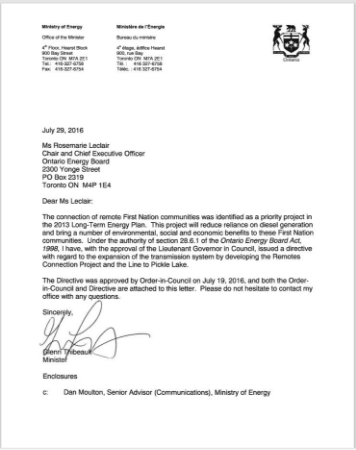
July 29, 2016: Ontario Energy Board (OEB) informed that the Lieutenant Governor in Council had made an order declaring that the construction of electricity transmission lines to Pickle Lake and extending north from Red Lake and Pickle Lake required to connect 16 named remote First Nation communities to the provincial electricity grid are needed as priority projects. Also received Directive from the Ontario Minister of Energy to amend the electricity transmission license issued to Wataynikaneyap Power LP – New Line to Pickle Lake and Connection of Remote First Nation Communities.

December 8, 2016: Assembly of First Nations (AFN) Resolution to support Wataynikaneyap Power as the designated transmitter; direct the National Chief to write a letter to Prime Minister Justin Trudeau to identify the project as a federal priority; and call on Ontario and Canada to immediately develop a funding framework to resource the project.

20
17

2017: Pikangikum funding application approved by Indigenous Services Canada. In December, clearing begins.

20
18

March 22, 2018: Funding framework was announced.

December 2018: Construction completed on the first project section: the 117 km line to Pikangikum First Nation (44 kV Distribution). Pikangikum First Nation was connected to the grid on December 20, 2018.

20
19

January 2019: Expanded mandate to include Mishkeegogamang and Ojibway Nation of Saugeen as partners. 24 First Nations are now in partnership.

April 1, 2019: The Ontario Energy Board (OEB) approved Wataynikaneyap Power’s LTC application. Project financing was secured, and Valard Construction was given notice to proceed as Engineering, Procurement, and Construction (EPC) contractor.

June 21, 2019: Environmental Assessment approvals received for Phase 1 of project.

July 8, 2019: Environmental Study Report approval received for Phase 2 of project.

2019: Environmental Assessment approvals received for Phase 2 of project.

October 10, 2019: Federal Species at Risk Act (SARA) approval received.

October 11, 2019: Provincial Environmental Site Assessment approval received.

20
20

February 2020: Endangered Species Act Effectiveness Monitoring Plan approval received, subject to engagement.

February 5, 2020: Construction begins on the project.

20
21

September 30, 2021: Ontario Energy Board Issues Decision on Wataynikaneyap Power LP’s First Rates Application. The OEB was satisfied that the terms of the Settlement Proposal should result in reasonable outcomes for WPLP, Ontario electricity transmission service customers and HORCI customers.

20
22

August 16, 2022:  Completion and energization of a 230 kV line, approximately 300 kilometres from Dinorwic to Pickle Lake, Ontario (Phase 1). The new 230 kV upgrade to Pickle Lake increases the load supply capabilities and provides operating flexibility to meet the needs of the remote communities that are energized in Phase 2 of the project.

October 5, 2022: North Caribou Lake First Nation connected to the grid.

November 8, 2022: Kingfisher Lake First Nation connected to the grid.

November 29, 2022: Ontario Energy Board Issues Decision on Wataynikaneyap Power LP’s Second Rates Application for 2022 electricity transmission rates and other charges.

20
23

May 2023: 44 kV to 115 kV Conversion of Pikangikum line completed.

July 6, 2023: Muskrat Dam assets energized and in service. Connection to the community is pending.

July 7, 2023: Bearskin Lake First Nation connected to the grid.

August 16, 2023: Wawakapewin First Nation connected to the grid.

September 19, 2023: Kasabonika Lake First Nation connected to the grid.

September 21, 2023: Wunnumin Lake First Nation connected to the grid.

November 2, 2023: Sachigo Lake First Nation connected to the grid.

November 30, 2023: Ontario Energy Board Issues Decision on Wataynikaneyap Power LP’s third Rate Application.

December 14, 2023: Kitchenuhmaykoosib Inninuwug (KI) and Wapekeka First Nation connected to the grid.

Looking to the Future

20
49

25 years following the operation date for the Wataynikaneyap Transmission Line, the First Nation partnership has the ability to purchase 100% of the Project and infrastructure.
Wataynikaneyap Power will pursue options to connect McDowell Lake First Nation, our 17th community, at a future date.